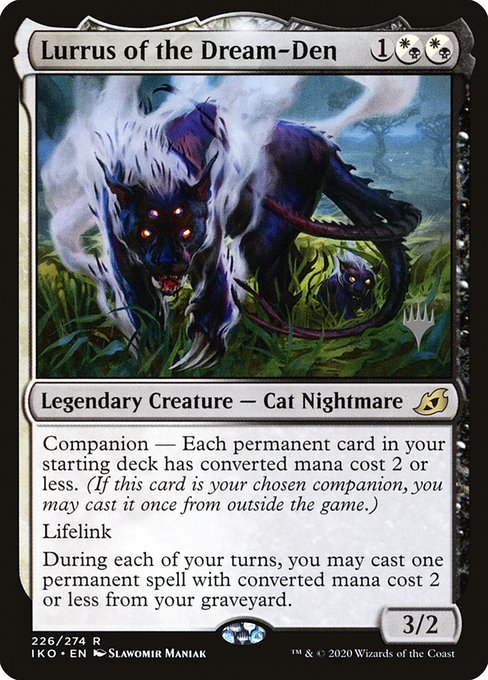
Lurrus of the Dream-Den


Legendary Creature — Cat Nightmare
Companion — Each permanent card in your starting deck has mana value 2 or less. (If this card is your chosen companion, you may put it into your hand from outside the game for  as a sorcery.)
Lifelink
Once during each of your turns, you may cast a permanent spell with mana value 2 or less from your graveyard.
3 / 2
- Set
- Ikoria: Lair of Behemoths Promos (PIKO #226p)
- Rarity
- Rare
- Mana value
- 3
- Released
- 2020-04-24
- Artist
- Slawomir Maniak
- EDHREC rank
- #2,782
- Colour identity


- Finishes
- Nonfoil, Foil
- Served from
- Local database
Commander bracket
Derived from card traits, not a ruling — bracket rules turn on how a deck intends to use a card. Bracket rules
EDHREC
Combos 90



Showing the 50 most played of 90.
Commander recommendations
Top synergy 50
Played far more in this commander's decks than elsewhere.
- Seal of Cleansing
- Animate Dead
- Cathar Commando
- Accursed Marauder
- Mishra's Bauble
- Kaya's Ghostform
- Kami of False Hope
- Stitcher's Supplier
- Selfless Spirit
- Angelic Renewal
- Dauthi Voidwalker
- Zulaport Cutthroat
- Bounty Agent
- Leonin Relic-Warder
- Skullclamp
- Wayfarer's Bauble
- Viscera Seer
- Entomb
- Dark Confidant
- Raise the Past
- Buried Alive
- Dance of the Dead
- Umbral Collar Zealot
- Triarch Praetorian
- Cruel Celebrant
- Marionette Apprentice
- Ripples of Undeath
- Corpse Knight
- Unearth
- Executioner's Capsule
- Soul-Guide Lantern
- Soul Snare
- Priest of Fell Rites
- Lotus Petal
- Elas il-Kor, Sadistic Pilgrim
- Spirited Companion
- Sun Titan
- Carrion Feeder
- Blood Artist
- Darksteel Mutation
- Sevinne's Reclamation
- Selfless Savior
- Altar of Dementia
- Snarling Gorehound
- Urza's Bauble
- Esper Sentinel
- Nihil Spellbomb
- Unmarked Grave
- Benalish Sleeper
- Chthonian Nightmare
Most included 50
Highest share of decks running them, distinctive or not.
- Plains
- Swamp
- Command Tower
- Sol Ring
- Arcane Signet
- Caves of Koilos
- Swords to Plowshares
- Isolated Chapel
- Elas il-Kor, Sadistic Pilgrim
- Animate Dead
- Skullclamp
- Seal of Cleansing
- Godless Shrine
- Zulaport Cutthroat
- Blood Artist
- Cathar Commando
- Accursed Marauder
- Kaya's Ghostform
- Cruel Celebrant
- Viscera Seer
- Selfless Spirit
- Path to Exile
- Tainted Field
- Kami of False Hope
- Mishra's Bauble
- Talisman of Hierarchy
- Vault of Champions
- Dauthi Voidwalker
- Wayfarer's Bauble
- Fetid Heath
- Stitcher's Supplier
- Marsh Flats
- Mind Stone
- Esper Sentinel
- Angelic Renewal
- Corpse Knight
- Orzhov Signet
- Bojuka Bog
- Marionette Apprentice
- Sun Titan
- Damn
- Dark Ritual
- Umbral Collar Zealot
- Dark Confidant
- Darksteel Mutation
- Entomb
- Shadowy Backstreet
- Bartolomé del Presidio
- Lotho, Corrupt Shirriff
- Phyrexian Tower
Format legality
Rulings
- 2020-04-17
Before shuffling your deck to become your library, you may reveal one card from outside the game to be your companion if your starting deck meets the requirements of the companion ability. You can't reveal more than one. It remains revealed outside the game as the game begins.
- 2020-04-17
For spells with
 in their mana costs, use the value chosen for X to determine the spell's mana value. For example, if a permanent spell costs , you could cast it with X as 1 but not as 2.
 - 2020-04-17
If a card in a player's deck has
in its mana cost, X is considered to be 0. - 2020-04-17
If a permanent card is put into your graveyard during your main phase and the stack is empty, you have a chance to cast it before any player may attempt to remove that card from your graveyard.
- 2020-04-17
If more than one player wishes to reveal a companion, the starting player does so first, and players proceed in turn order. Once a player has chosen not to reveal a companion, that player can't change their mind.
- 2020-04-17
If you cast a spell from your graveyard using another permission, Lurrus's effect doesn't apply. You can cast another permanent spell from your graveyard.
- 2020-04-17
If you cast one permanent spell from your graveyard and then have a new Lurrus come under your control in the same turn, you may cast another permanent spell from your graveyard that turn.
- 2020-04-17
If you reveal a companion outside the game, for as long as it remains there, you may pay
any time you could cast a sorcery (that is, you have priority during your main phase and the stack is empty). Once you do, you put it into your hand and behaves like any other card you've brought into the game. For example, if it's discard, countered, or destroyed, it's put into your graveyard, remaining in the game. This is a change from previous rules. - 2020-04-17
Lurrus doesn't care about instant and sorcery cards in your starting deck. They may have any mana value.
- 2020-04-17
Lurrus doesn't let you play lands from your graveyard.
- 2020-04-17
Once you begin to cast the spell, losing control of Lurrus won't affect the spell. You can finish casting it as normal.
- 2020-04-17
The companion ability has no effect if the card is in your starting deck and creates no restriction on putting a card with a companion ability into your starting deck. For example, Zirda may be in your starting deck even if your other permanent cards don't all have activated abilities.
- 2020-04-17
The companion's other abilities apply only if the creature is on the battlefield. They have no effect while the companion is outside the game.
- 2020-04-17
The requirements of the companion ability apply only to your starting deck. They do not apply to your sideboard.
- 2020-04-17
You may have one companion in the Commander variant. Your deck, including your commander, must meet its companion requirement. Your companion is not one of your one hundred cards.
- 2020-04-17
You must follow the normal timing permissions and restrictions of the spell you cast from your graveyard.
- 2020-04-17
You must pay the costs to cast that spell. If it has an alternative cost, such as a mutate cost, you may cast it for that cost instead.
- 2020-04-17
Your companion begins the game outside the game. In tournament play, this means your sideboard. In casual play, it's simply a card you own that's not in your starting deck.
- 2020-06-01
If you reveal a companion outside the game, for as long as it remains there, you may pay
any time you could cast a sorcery (that is, you have priority during your main phase and the stack is empty). Once you do, you put it into your hand and behaves like any other card you've brought into the game. For example, if it's discarded, countered, or destroyed, it's put into your graveyard, remaining in the game. This is a change from previous rules. - 2020-06-01
Once you put your companion into your hand, it behaves like any other card you’ve brought into the game. For example, if it’s countered or destroyed, it’s put into your graveyard, remaining in the game.
- 2020-06-01
Paying
to put your companion into your hand is a special action. It doesn't use the stack and players can't respond to it. Once you take this action, you may cast that card if it's legal to do so before any other player can take actions. - 2020-06-01
Wizards of the Coast has issued functional errata for the Companion mechanic. Instead of casting companions from outside the game: Once per game, any time you could cast a sorcery (during your main phase when the stack is empty), you can pay
to put your companion from your sideboard into your hand. This is a special action, not an activated ability. It happens immediately and can’t be responded to. It can’t be countered or stopped by cards like Phyrexian Revoker. For more information please see https://magic.wizards.com/en/articles/archive/news/june-1-2020-banned-and-restricted-announcement